Home › Guides › Anatomy of a Cartridge
Anatomy of a Cartridge
A modern cartridge is four parts working together: a bullet that flies to the target, a case that holds everything, powder that burns to launch it, and a primer that lights the fire. Here's what every part does.
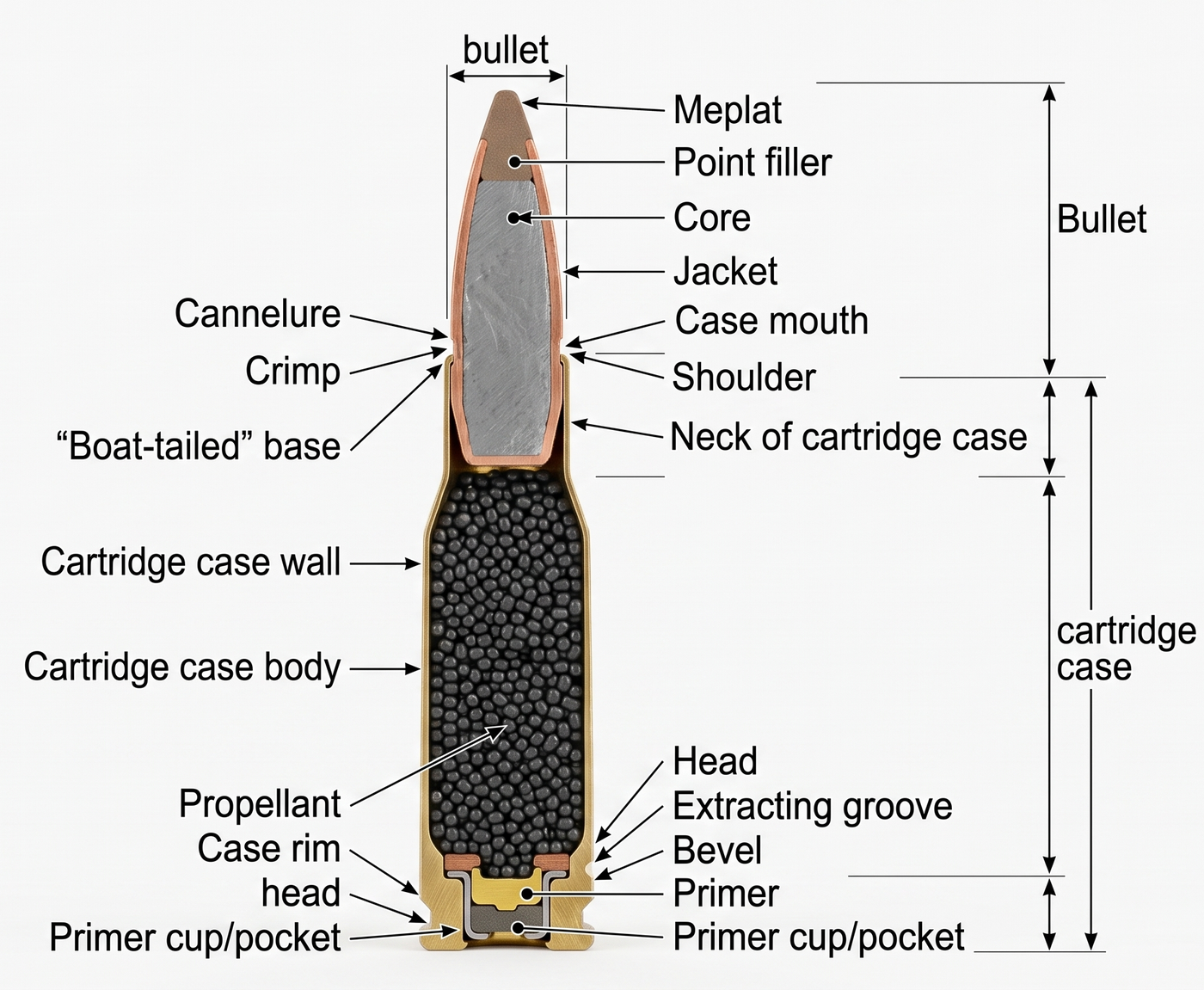
The four main parts
1 · Bullet (the projectile)
The only part that leaves the barrel. It's usually a lead core in a copper jacket, shaped for flight. Its weight (in grains), diameter (caliber) and profile set the ballistic coefficient — how well it holds velocity against drag. Heavier, sleeker bullets buck the wind and drop less far downrange. A common mistake: calling the whole cartridge a "bullet." The bullet is just the tip.
2 · Case (the housing)
Almost always brass, the case holds the powder, seats the bullet in its neck, and seals the chamber against escaping gas when fired. Brass is used because it expands to grip the chamber under pressure, then springs back so the case can extract. It's also reloadable — a fired case can be resized, reprimed, recharged and reused several times.
3 · Powder (the propellant)
Modern smokeless powder — not an explosive, but a fast-burning propellant. When lit it turns to expanding gas in a few thousandths of a second, driving the bullet down the bore. The type and amount of powder set the muzzle velocity and pressure, which is why published load data must be followed exactly.
4 · Primer (the igniter)
A small cup of impact-sensitive compound in the base of the case. The firing pin dents it, it sparks, and that spark ignites the powder. Two families exist: centerfire, where the primer sits in the center of the case head and is replaceable (reloadable), and rimfire, where the compound is spun into the rim itself — cheaper, but not reloadable (this is why .22 LR cases are discarded).
Case features that matter
Rim & extractor groove — the lip and channel at the base that the rifle's extractor grabs to pull the case out. "Rimless," "belted" and "rebated" describe different rim styles.
Head & web — the thick base of the case that contains the highest pressure. The headstamp stamped here identifies the caliber and maker.
Body, shoulder & neck — on a bottleneck case the wide body tapers at the shoulder down to a narrow neck that grips the bullet. That shape packs more powder behind a smaller bullet — the reason high-velocity rifle rounds are bottlenecked while most pistol rounds are straight-walled.
How it fires, in order
Firing pin strikes the primer → primer sparks → powder ignites and becomes high-pressure gas → gas pushes the bullet out of the case neck and down the rifled barrel, spinning it for stability → the empty case is extracted and ejected. The whole sequence takes about one to two milliseconds.
Compare .22 LR through .50 BMG side by side at true relative size, with dimensions, velocity and energy.
Open the Cartridge ComparisonEducational reference only. Always follow published load data and all firearm safety rules; never substitute this page for a manufacturer's specifications.