Home › Guides › Understanding scopes & gear
Understanding Rifle Scopes & Gear
A plain-English reference for anyone getting into rifle shooting — how a scope works, the gear around it, common cartridges, and the words the pros throw around. Bookmark it.
1 · Understanding scopes
A rifle scope is a small telescope with an aiming reference (the reticle) inside it. Light enters the front objective lens, the image is focused and magnified through the tube, and you view it through the rear ocular lens. Turrets move the reticle relative to the bore so your point of aim matches your point of impact.
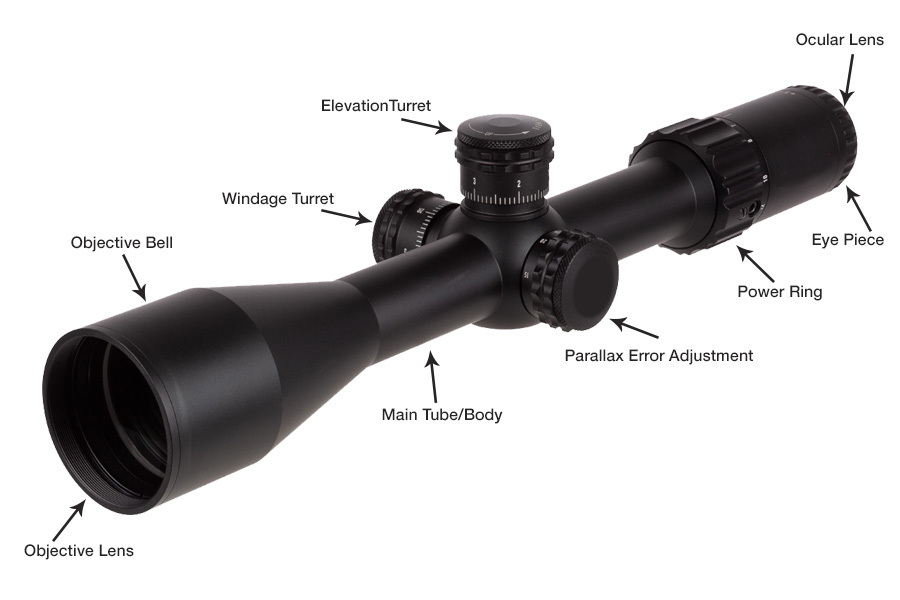
The parts that matter
- Objective lens & bell — the big front lens; a larger objective gathers more light (brighter image) but adds bulk.
- Main tube / body — usually 1 inch, 30 mm or 34 mm. Bigger tubes allow more internal adjustment (elevation travel).
- Elevation turret (top) — moves impact up/down; this is what you dial for drop.
- Windage turret (side) — moves impact left/right for wind and zeroing.
- Parallax adjustment — focuses the target on the same plane as the reticle so your eye position doesn't shift the aim (critical at long range and high magnification).
- Power ring — changes magnification on a variable scope (e.g. 5–25×).
- Ocular / eye piece — focuses the reticle to your eye (diopter).
- Reticle — the aiming mark: a simple duplex, or a mil/MOA grid with hold points.
2 · Types of scopes
LPVO (1–x)
Low-power variable optics like 1–6× or 1–10×. Fast up close at 1×, reach out at the top end. Great all-rounder for MSRs.
Hunting
Light, simple, often 3–9× or 4–12× with a duplex reticle and capped turrets. Set a zero (or MPBR) and hold.
Precision / tactical
High magnification (5–25×+), FFP mil/MOA reticle, exposed turrets with lots of travel, parallax adjustment. Built to dial.
Rimfire
Tuned to parallax at closer distances (often 50 yd) and lighter recoil; matched to .22 LR trajectories.
Red dot / prism
Non-magnified (or low fixed) aiming for speed at close range. No holdover math — great backup or CQB, not for distance.
Fixed vs variable
Fixed power is simpler and rugged; variable adapts to the shot. Most shooters run a variable today.
3 · Cartridges compared
A quick look at popular cartridges and representative match/hunting loads. Velocities and BCs are typical figures — always chronograph and confirm. Use the free AHL Sight app to run exact drop and wind for any of these.
| Cartridge | Bullet | MV (fps) | G1 BC | Typical use |
|---|---|---|---|---|
| .22 LR | 40 gr LRN | 1,080 | 0.120 | Plinking, training, small game |
| .223 Rem / 5.56 | 77 gr SMK | 2,750 | 0.372 | MSR, varmint, target |
| 6.5 Creedmoor | 140 gr ELD-M | 2,710 | 0.610 | Precision, deer |
| 6.5 PRC | 147 gr ELD-M | 2,910 | 0.697 | Precision, big game |
| .270 Win | 130 gr | 3,060 | 0.460 | Big game |
| 7mm PRC | 175 gr ELD-M | 3,000 | 0.689 | Long-range hunting |
| .308 Win | 175 gr SMK | 2,600 | 0.505 | Precision, utility |
| .30-06 | 180 gr | 2,700 | 0.507 | Big game, all-round |
| .300 Win Mag | 190 gr | 2,900 | 0.600 | Long-range, big game |
| .338 Lapua | 285 gr ELD-M | 2,745 | 0.789 | Extreme long range |
| .50 BMG | 750 gr A-MAX | 2,820 | 1.050 | Extreme long range |
Higher muzzle velocity shoots flatter; higher ballistic coefficient (BC) keeps speed and resists wind. The two together define how far a cartridge stays easy to hit with.
4 · Rangefinders
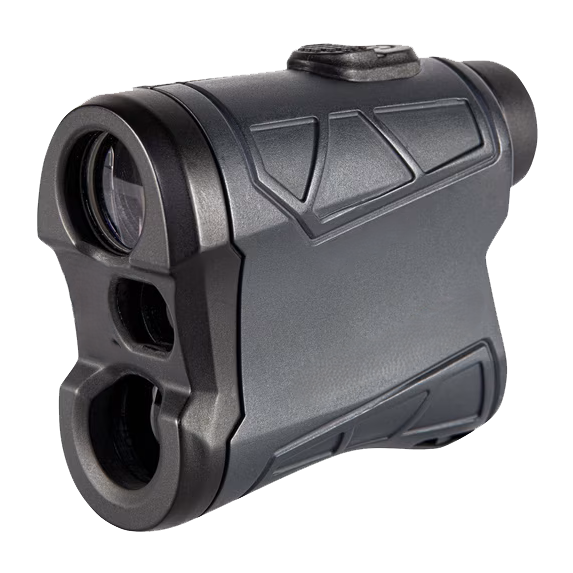
You can't dial the right drop until you know the distance. Two ways to range:
- Laser rangefinder — fires an invisible pulse and times the return. Fast and accurate; look for enough max range for your shots, angle (incline) compensation, and a clear readout.
- Reticle ranging — measure a known-size target in mils/MOA and do the math (AHL Sight' Rangefinder tab solves it either direction). No batteries, but slower and less precise.
Angle matters: shooting steeply up or down, only the horizontal distance drives drop. Good laser units and the app account for it.
5 · Targets
Match the target to the job:
- Grid / sight-in targets — 1-inch squares make zeroing and group measurement easy (and make the Target Cam scale step trivial).
- Splatter targets — impacts flash a bright ring so you can spot hits without walking downrange.
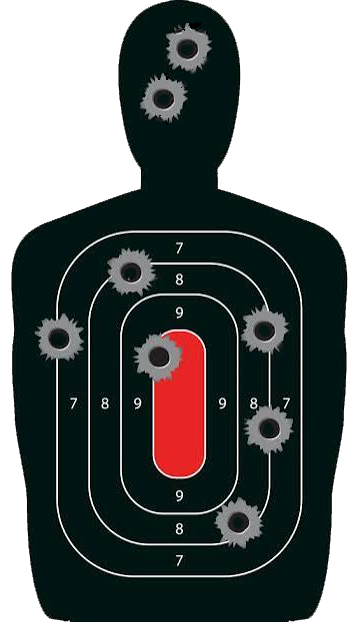
- Silhouette / scoring targets — scored rings for practice and qualification.
- Steel — instant audible feedback at distance; use proper distance and calibers for safety.
Whatever you shoot, photograph the group and let Target Cam measure it and hand you the correction.
6 · Terms & definitions
- Zero
- The distance at which your point of aim equals your point of impact.
- MPBR (Maximum Point-Blank Range)
- A zero that keeps the bullet inside a chosen target circle across the widest span, so you can hold dead-on. Guide →
- DOPE
- "Data On Previous Engagements" — your recorded drop and wind holds at each distance.
- MOA (Minute of Angle)
- An angle ≈ 1.047″ at 100 yd; ~1 inch per 100 yards. Common ¼-MOA clicks.
- MIL (Milliradian)
- An angle = 3.6″ at 100 yd (10 cm at 100 m). Common 0.1-mil clicks.
- Ballistic Coefficient (BC)
- How well a bullet resists drag — higher BC = flatter, less wind drift. Given in G1 or G7 reference models.
- G1 vs G7
- Two standard drag models. G7 fits modern boat-tail bullets better at long range.
- Elevation / Windage
- Up-down and left-right scope adjustments.
- Click
- One turret detent — a fixed angular amount (e.g. ¼ MOA or 0.1 mil).
- Subtension
- How many inches an angle covers at a distance — it grows with range.
- Parallax
- Apparent reticle shift when your eye moves off-axis; adjusted to match target and reticle planes.
- FFP / SFP
- First / second focal plane — whether the reticle scales with magnification.
- Sight height
- Distance from bore centerline to scope centerline; affects near trajectory.
- Twist rate
- How fast the barrel spins the bullet (e.g. 1:8″) — needed for stability and spin drift.
- Spin drift
- Gyroscopic sideways walk of the bullet at long range. Guide →
- Coriolis
- Deflection from the Earth's rotation over a long flight.
- Transonic
- Where the bullet slows through ~Mach 1.2 and groups open up.
- Muzzle velocity (MV)
- Speed of the bullet as it leaves the barrel — the single biggest input to trajectory.
AHL Sight turns all of this into real numbers for your rifle: zero, drop, wind, dial-in and group analysis.
Open AHL SightAHL Sight is a planning aid. Always confirm your zero with live fire and follow all firearm safety rules.